Run GLM-4.7-Flash Locally (30B-A3B, 19 GB)
GLM-4.7-Flash on Ollama: MIT licence, 30B-A3B MoE, 19 GB at Q4_K_M. Hardware needs, reported benchmarks, and why local inference sends nothing to Z.ai.
GLM-4.7-Flash is Z.ai's 30B-A3B mixture-of-experts model, released under the MIT licence, and it runs locally in about 19 GB at Q4_K_M. Pull it with ollama pull glm-4.7-flash, select it in Typilot, and every Polish and Notes command runs on your own hardware with nothing sent to Z.ai or anyone else.
Here is what the model is, what hardware it needs, how its published benchmarks compare, and where it honestly falls short of cloud models.
What GLM-4.7-Flash is
GLM-4.7-Flash comes from Z.ai (Zhipu), the lab behind the GLM family. Its Hugging Face model card describes a 30B-A3B mixture-of-experts model: roughly 31B parameters in total, with about 3B active for each token. Only the active experts compute per token, so it generates faster than a dense 30B model would, while the full set of weights still has to fit in memory.
The licence is MIT, which permits local, commercial, and offline use. The Ollama library lists a 198K-token context window for every tag, and the model has passed 2.1 million downloads there.
Hardware requirements
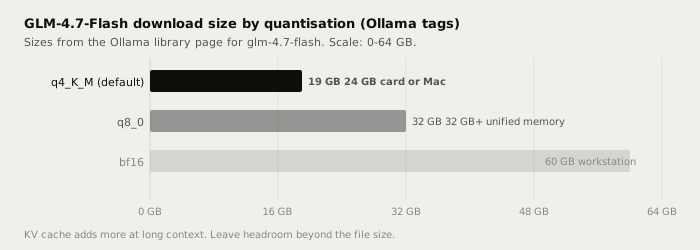
The Ollama library lists three tags. Size on disk is a floor for memory use, because the KV cache grows with context length.
| Tag | Download size | Realistic target hardware |
|---|---|---|
q4_K_M (default latest) | 19 GB | 24 GB GPU, or a Mac with 24 GB+ unified memory |
q8_0 | 32 GB | 32 GB+ unified memory or a 32 GB GPU |
bf16 | 60 GB | Workstation-class memory |
Third-party guides give different minimums. Unsloth's documentation says the model runs on 24 GB of RAM, VRAM, or unified memory, with about 18 GB needed for its 4-bit build. Codecademy lists 16 GB as a minimum and 32 GB as recommended. Treat 24 GB as the comfortable floor for the default tag. If you have less, see the RAM guide for local LLMs or running a local LLM without a GPU.
Running it in Ollama
# Check your Ollama version first (recent releases support the model)
ollama --version

# Pull the default Q4_K_M build (~19 GB)
ollama pull glm-4.7-flash

# Quick smoke test
ollama run glm-4.7-flash "Rewrite this politely: send me the report now."
Then open Typilot Preferences, go to Models, pick GLM-4.7-Flash from your downloaded Ollama models, and set it as the default for Polish or Notes. The Ollama setup docs cover the connection flow.
Unsloth's GLM-4.7-Flash guide says it does not recommend running its GGUF through Ollama because of possible chat-template compatibility issues, and points to llama.cpp, LM Studio, or Jan instead. The official Ollama library build is a separate package, but test your output quality on a few real prompts before relying on it.
What the benchmarks say
The model card compares GLM-4.7-Flash with Qwen3-30B-A3B-Thinking-2507 and GPT-OSS-20B. These are Z.ai's own reported numbers, not independent tests.
| Benchmark | GLM-4.7-Flash | Qwen3-30B-A3B-Thinking-2507 | GPT-OSS-20B |
|---|---|---|---|
| AIME 25 | 91.6 | 85.0 | 91.7 |
| GPQA | 75.2 | 73.4 | 71.5 |
| SWE-bench Verified | 59.2 | 22.0 | 34.0 |
| tau-squared Bench | 79.5 | 49.0 | 47.7 |
| BrowseComp | 42.8 | 2.29 | 28.3 |
The standout is agentic and coding work (SWE-bench Verified, tau-squared Bench). For everyday dictation cleanup, email rewrites, and meeting summaries, these benchmarks matter less than they look: those tasks are well within what much smaller models do. Compare with Qwen3-Coder for pure coding, gpt-oss for a lighter 20B option, or Qwen vs Llama vs Gemma for general writing.
Honest limits versus cloud models
A 3B-active local model is not Claude Opus, Sonnet, or Fable. Frontier cloud models still lead on long multi-step reasoning, novel architecture decisions, and polish on difficult prose. Local wins elsewhere:
| GLM-4.7-Flash local | Cloud frontier model | |
|---|---|---|
| Text leaves your device | Never | Always |
| Works offline | Yes | No |
| Per-request cost | $0 | Pay-per-token |
| Rate limits | None | Applies |
| Peak reasoning quality | Good | Best |
For the broader trade-off, read local LLM vs Claude Opus and Sonnet.
Privacy: open weights, local inference
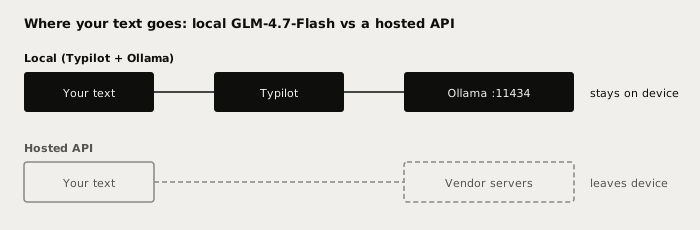
The weights are a file on your disk. Ollama serves them at localhost:11434, and inference needs no network. Pull the model, disconnect from the internet, and run a Typilot command: it still works. That is the whole privacy argument, and it holds regardless of which lab trained the model. For the longer discussion see is it safe to run Chinese AI models locally, and for the wider landscape the best Chinese open-source LLMs to run locally.
Running GLM-4.7-Flash through a Z.ai hosted API is a different data path from running the weights locally. Local inference through Ollama sends nothing to Z.ai.
The short version
GLM-4.7-Flash is an MIT-licensed 30B-A3B mixture-of-experts model that fits a 24 GB machine at Q4_K_M (19 GB). Run ollama pull glm-4.7-flash, choose it in Typilot, and your text stays on your device. It posts strong reported coding and agent scores for its size, while cloud frontier models still win on the hardest reasoning.
Try Typilot free for three days at /download. The architecture proof is at /security.
Common questions.
How much memory does GLM-4.7-Flash need locally?+
The default Ollama tag (q4_K_M) is a 19 GB download, so a 24 GB GPU or a Mac with 24 GB or more unified memory is the comfortable floor. The q8_0 tag is 32 GB and bf16 is 60 GB. The KV cache adds more memory at long context, so leave headroom beyond the file size.
Is GLM-4.7-Flash open source and free for commercial use?+
Its Hugging Face model card lists the MIT licence, which permits local, commercial, and offline use. The weights are a 30B-A3B mixture-of-experts model with about 31B total and 3B active parameters per token.
What is the Ollama command for GLM-4.7-Flash?+
`ollama pull glm-4.7-flash` downloads the default 19 GB Q4_K_M build, and `ollama run glm-4.7-flash` starts it. Then select it in Typilot Preferences under Models to use it for Polish and Notes. Unsloth advises that its own GGUF may have chat-template issues in Ollama, so test output quality on real prompts.
Does running GLM-4.7-Flash locally send data to Z.ai?+
No. Ollama serves the model at localhost:11434 and inference needs no network after the one-time download. Using Z.ai's hosted API is a different data path from running the open weights on your own machine.