Best Chinese Open Source LLMs to Run Locally
DeepSeek R1 distills and Qwen3 are the Chinese open-source LLMs you can actually run on a laptop. MIT and Apache 2.0, 5-20 GB at Q4, nothing sent to the vendor.
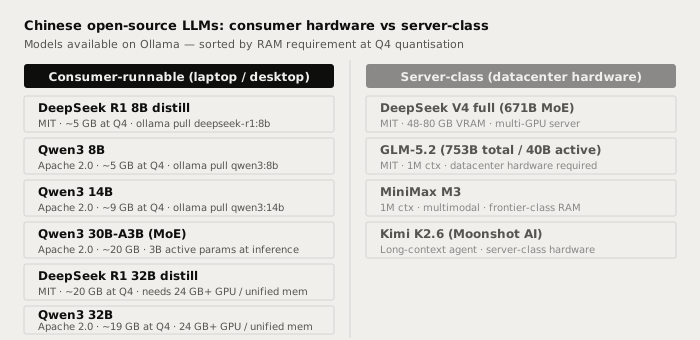
DeepSeek R1's distilled 8B and 32B variants and the Qwen3 family are the two Chinese open-source model lines worth running locally in 2026. Both are available on Ollama, run on consumer RAM levels (5-20 GB at standard Q4 quantisation), and use permissive licences - MIT for DeepSeek distills, Apache 2.0 for Qwen3 - that allow unrestricted commercial use. The headline models from each Chinese lab (GLM-5.2, MiniMax M3, Kimi K2.6, the full DeepSeek V4) are datacenter-class and require hundreds of gigabytes of VRAM; they do not run on a laptop or desktop.
Here is what to pull, what to expect, and why local deployment is the only option that answers the privacy question.
What local means for privacy
When you download model weights via Ollama and run a command, inference happens at localhost:11434. No request goes to DeepSeek, Alibaba, or any third-party server. The vendor cannot see your prompts, your outputs, or the fact that you are running their model. This is the structural difference between a local deployment and a cloud API: the data path is local the moment the weights are on your machine.
The concern about Chinese-origin LLMs has always been about cloud API calls, not open weights. Running DeepSeek R1 locally via Ollama is architecturally identical to running Llama or Gemma locally - weights are downloaded once, inference runs on your CPU or GPU, and nothing leaves the device. Verify it: disable your internet connection and the model keeps running.
The headline models are not for laptops
The most-discussed Chinese open-source releases of 2025-2026 are not consumer hardware picks:
| Model | Parameters | Minimum VRAM | Verdict |
|---|---|---|---|
| DeepSeek V4 full (671B MoE) | 671B total | 48-80 GB | Multi-GPU server |
| GLM-5.2 (Z.AI) | 753B total / 40B active | Datacenter | Not consumer-runnable |
| MiniMax M3 | 1M ctx, multimodal | Frontier-class | Not consumer-runnable |
| Kimi K2.6 (Moonshot AI) | Server-class | Server-class | Not consumer-runnable |
These are the models that dominate benchmark coverage. None of them run on a MacBook or a single consumer GPU. The models that actually fit on consumer hardware are distilled and mid-sized releases from the same labs.
DeepSeek R1: the distilled variants
DeepSeek distilled the reasoning capabilities of its full R1 model (671B parameters, MIT licence) into a series of smaller instruction-tuned models that retain a significant proportion of the original's step-by-step reasoning.
| Model | Parameters | RAM at Q4_K_M | Best for |
|---|---|---|---|
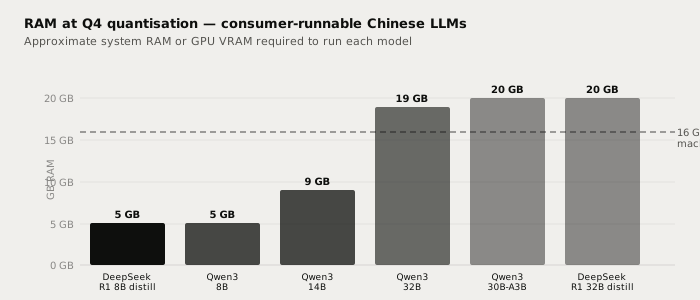
| deepseek-r1:8b | 8B | ~5 GB | Any 8 GB+ GPU or 16 GB unified memory |
| deepseek-r1:32b | 32B | ~20 GB | RTX 3090/4090 or 24 GB+ unified memory |
ollama pull deepseek-r1:8b    # ~5 GB - runs on any 8 GB GPU
ollama pull deepseek-r1:32b   # ~20 GB - needs 24 GB+ GPU or unified memory
The 8B distill handles rewrites, email drafts, and short summaries competently. The step-by-step reasoning (R1's core design) shows clearly on structured prompts - it works through a problem before outputting, which improves accuracy on analytical tasks like "review this paragraph and list three specific improvements." The 32B distill closes the quality gap further and is competitive with mid-tier cloud models on structured writing and light reasoning.
The full DeepSeek R1 is 671B parameters and requires 320 GB+ of VRAM across multiple server GPUs - it is explicitly not what this post covers. The distills are separate, independently useful models, not a reduced version of the same download.
Qwen3: eight sizes, Apache 2.0
The Qwen3 family (Alibaba, Apache 2.0, April 2025) covers 119 languages, supports a toggleable thinking mode, and ships in eight sizes from 0.6B to 235B parameters. The consumer-runnable range is 8B through 32B:
| Model | Active params | RAM at Q4 | Notes |
|---|---|---|---|
| qwen3:8b | 8B | ~5 GB | 16 GB machine pick, 128K context |
| qwen3:14b | 14B | ~9 GB | 16 GB machine, stronger analytical writing |
| qwen3:30b-a3b | 30B total / 3B active | ~20 GB | MoE: 30B knowledge, 3B inference speed |
| qwen3:32b | 32B | ~19 GB | Best prose quality in the family |
ollama pull qwen3:8b          # 16 GB machine - the default pick
ollama pull qwen3:14b         # stronger writing, still fits 16 GB
ollama pull qwen3:30b-a3b     # MoE: wide knowledge, mid-range hardware speed
ollama pull qwen3:32b         # best quality, needs 24 GB+
The Qwen3 30B-A3B is the most interesting option: it is a mixture-of-experts model that activates only 3 billion parameters per token at inference time. Storage is ~20 GB but it runs at speeds comparable to a much smaller dense model. For tasks that benefit from broader knowledge - documents, long emails, structured reports - it consistently outperforms the 8B on the same hardware at comparable generation speeds.
On independent writing benchmarks, Qwen3 32B scores around 82/100 where cloud frontier models (Claude Sonnet, Fable) score 90+. That is the honest gap on prose writing - narrower than many expect, but real on long creative drafts and complex multi-step reasoning. See local LLM vs Claude: the honest trade-off for the full comparison.
Licences: MIT and Apache 2.0 in practice
Both licences allow commercial use without royalties or field-of-use restrictions.
- MIT (DeepSeek R1 distills): fewest restrictions of any open-source licence. Modify, use, distribute, or sell freely.
- Apache 2.0 (Qwen3): includes a patent grant and requires the licence notice to be included, but equally permissive for commercial use.
Neither has a monthly-active-user clause or revenue threshold - the restrictions that attach to some other model licences.
Running a Chinese-origin LLM locally via Ollama means nothing is sent to the vendor. The privacy question about DeepSeek and Qwen is about cloud API calls, not open weights - inference at localhost:11434 is off the network entirely.
Which model to start with
For most 16 GB machines, start with Qwen3 8B (ollama pull qwen3:8b). It is the best-rounded pick at that RAM level: 128K context window, 119-language support, reliable on rewrites and short summaries, comfortable to run on CPU or GPU.
If your work is analytical or structured, try the DeepSeek R1 8B distill alongside it. The chain-of-thought design makes it sharper on prompts that require working through constraints before outputting.
For 24 GB+ machines: Qwen3 32B for prose and long-form writing quality, DeepSeek R1 32B distill for structured reasoning tasks.
For a full comparison against non-Chinese local models (Gemma 4, Phi-4, Mistral Small), see best local LLMs for writing in 2026.
Setting up with Typilot
Typilot connects to any Ollama model automatically at http://localhost:11434. Once Ollama is running and a model is pulled, open Typilot and select the model under Settings > General. No API key or URL change is needed.
With a Chinese-origin local model active, the full command set works in any text field across any application - the text never reaches any server at any point in the pipeline:
rew: this paragraph        → rewrite in place
fix: this sentence         → fix grammar and phrasing
sum: these meeting notes   → summarise a transcript
gen: draft a reply to      → generate from a short prompt
imp: this draft            → improve structure and tone
The Ollama setup docs have the full initial configuration. The run a local AI assistant guide is the recommended starting point if Ollama is not yet installed.
The short version
For consumer hardware, the two Chinese open-source model families that actually run locally in 2026 are DeepSeek R1 distills (MIT, 8B at ~5 GB or 32B at ~20 GB) and Qwen3 (Apache 2.0, same RAM footprints). Both run via Ollama with a single pull command, and both run entirely offline - nothing is sent to DeepSeek, Alibaba, or any other server once the weights are downloaded. The headline Chinese models (GLM-5.2, MiniMax M3, Kimi K2.6, DeepSeek V4 full) are server-class and do not run on laptop or desktop hardware. Typilot connects to any Ollama model on first launch and puts rewrite, polish, and 27 other commands on a hotkey in every app on your machine - 3-day free trial. The security page shows exactly what touches your hardware and what never does.
Common questions.
Which Chinese open-source LLMs can I run on a laptop?+
DeepSeek R1 distills (8B at ~5 GB or 32B at ~20 GB, MIT licence) and the Qwen3 family (8B at ~5 GB, 14B at ~9 GB, 32B at ~19 GB, Apache 2.0) are the two Chinese model lines that run on consumer hardware via Ollama. The headline models - GLM-5.2, MiniMax M3, Kimi K2.6, and the full DeepSeek V4 - are datacenter-class and require hundreds of gigabytes of VRAM.
Is it safe to run DeepSeek or Qwen locally for privacy?+
Yes. When you run DeepSeek R1 or Qwen3 via Ollama, inference happens at localhost:11434 and nothing is sent to DeepSeek, Alibaba, or any third-party server. The privacy concern about Chinese-origin LLMs is about cloud API calls, not open weights - once the model is downloaded, it runs entirely offline with no network path back to the vendor.
What is the difference between DeepSeek R1 and DeepSeek V4?+
DeepSeek R1 is a reasoning model (chain-of-thought design) with MIT-licensed distilled variants at 8B and 32B parameters that run on consumer hardware. DeepSeek V4 is the full 671B mixture-of-experts model that requires 48-80 GB of VRAM across multiple server GPUs and does not run on a laptop or desktop. For local use, always pull the distilled variants: ollama pull deepseek-r1:8b or deepseek-r1:32b.
How does Qwen3 30B-A3B fit on mid-range hardware?+
Qwen3 30B-A3B is a mixture-of-experts model that activates only 3 billion parameters per token during inference, despite having 30B total parameters. It requires ~20 GB of storage but runs at speeds comparable to a much smaller dense model - making 30B-scale knowledge accessible on 24 GB GPUs or Apple Silicon machines with 24 GB unified memory.