Qwen vs Llama vs Gemma: Which to Run Locally
Qwen3, Llama, and Gemma all run on a 16 GB machine via Ollama. Here is which family to choose for multilingual, Apple Silicon speed, ecosystem, and image tasks.
For a 16 GB machine, Qwen3 8B, Llama 3.1 8B, and Gemma 4 12B all fit in Ollama and run entirely on device - your text never touches a network socket. The right pick depends on what you are writing and where you run it: Qwen3 is the strongest multilingual and STEM choice, Llama has the widest local-tool ecosystem and clean English prose, and Gemma 4 is the fastest option on Apple Silicon and the only one of the three with built-in image understanding.
Here is how the three families differ by use case, hardware tier, and licence - and which one to pull first.
The families at a glance
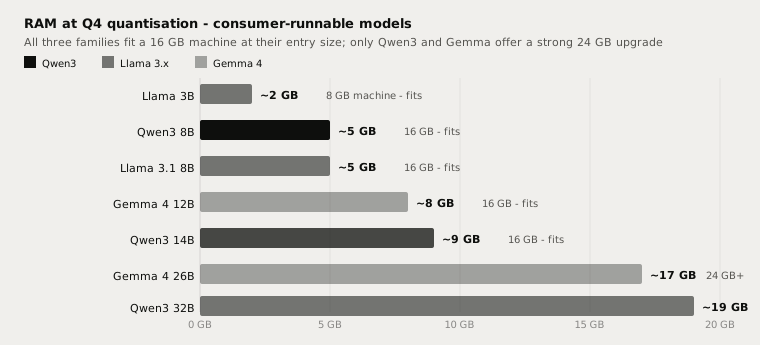
| Family | Entry model | RAM at Q4 | 24 GB upgrade | Licence |
|---|---|---|---|---|
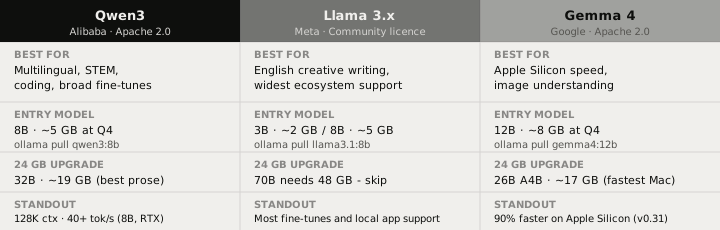
| Qwen3 | 8B | ~5 GB | 32B (~19 GB) | Apache 2.0 |
| Llama 3.x | 3B / 3.1 8B | ~2 GB / ~5 GB | 70B needs 48 GB | Meta Community |
| Gemma 4 | 12B | ~8 GB | 26B (~17 GB) | Apache 2.0 |
All three pull and run in Ollama with a single command at localhost:11434. No API key, no account. The privacy guarantee is identical across all three: once the model is downloaded, it runs entirely offline - nothing reaches Alibaba, Meta, Google, or any third party.
Qwen3 - multilingual and STEM
Qwen3 (Alibaba, Apache 2.0, April 2025) is available in four consumer sizes: 8B (~5 GB at Q4), 14B (~9 GB), 32B (~19 GB), and the mixture-of-experts 30B-A3B (~20 GB, with only 3B parameters active per token during inference). All four support a 128K token context window.
The most important advantage is multilingual quality. Qwen3 treats Chinese, Japanese, Korean, and the major European languages as first-class - not afterthoughts. If your writing mixes languages, or if a significant share of your work is in a non-English language, no other consumer-runnable model at the same RAM tier comes close. For STEM, structured reasoning, and code generation, Qwen3 also consistently beats models of the same nominal parameter count from other families on standard benchmarks.
For English prose, Qwen3 8B handles rewrites, summaries, and email drafts well. Independent writing benchmarks score Qwen3 32B around 82/100 compared to 90+ for cloud frontier models (localaimaster.com/freeacademy.ai data). The gap is most visible on long creative drafts and very subtle stylistic matching; for iterative prose work with human editing, it is practical.
Apache 2.0 means no attribution requirement and no revenue thresholds - use it commercially without checking a licence.
ollama pull qwen3:8b
ollama run qwen3:8b
Llama 3.x - the broad-ecosystem pick
The Llama family (Meta) has the widest support across local AI tools. LM Studio, Open WebUI, AnythingLLM, and the majority of fine-tuned variants and custom Ollama integrations have Llama as their reference model. For users who need to run third-party pipelines, drop into an existing RAG setup, or find community fine-tunes for specific tasks, Llama's ecosystem coverage is unmatched.
Consumer-runnable sizes: Llama 3B at roughly 2 GB is the lowest-RAM entry point across all three families and runs on any 8 GB machine. Llama 3.1 8B at roughly 5 GB is the most widely used Ollama model and the natural starting point for most users. Llama 3.3 70B gives near-cloud output quality but needs roughly 42 GB at Q4 quantisation - that is a 48 GB M4 Max or dual 24 GB GPUs, not a typical consumer setup.
For English creative writing, Llama 3.x produces clean, idiomatic prose with strong structural coherence. It is the family that most third-party writing fine-tunes target, so the selection of task-specific Llama variants is larger than for Qwen or Gemma.
Licence note: the Meta Llama Community licence permits commercial use for most organisations. It requires attribution and applies revenue thresholds for companies above $700M annual turnover. For personal use, freelancers, and most companies it is effectively permissive - but it is not Apache 2.0. Qwen3 and Gemma 4 carry no such conditions.
ollama pull llama3.1:8b
ollama run llama3.1:8b
Gemma 4 - Apple Silicon and multimodal
Gemma 4 (Google, Apache 2.0) is the best choice for two specific scenarios: running on Apple Silicon, and any task that involves images.
Apple Silicon speed. Ollama v0.31.1 (June 2026) added multi-token prediction for Gemma 4, cutting average token generation time by up to 90% on M-series chips. The speedup is on by default and requires no configuration. On an M3 Pro or M4 Max, Gemma 4 26B generates at a pace that feels genuinely interactive. No other model in this comparison receives a comparable Apple-Silicon speedup from the current Ollama release.
Gemma 4 12B (released June 3, 2026) fits in roughly 8 GB at Q4 quantisation - inside any 16 GB Mac or GPU. Google states its benchmarks approach the 26B on many tasks at less than half the memory. It also handles images: pass a screenshot, diagram, or document scan and it reads and reasons over the visual content. The original Gemma 4 family launched on April 2, 2026; the 12B was added as a follow-up on June 3, 2026 to fill the 16 GB slot.
Gemma 4 26B A4B uses a mixture-of-experts design - 26B total parameters, but only around 4B are active per token during inference, so compute load is lower than the parameter count suggests. It needs roughly 17 GB at Q4, fitting a 24 GB Mac or an RTX 4090.
ollama pull gemma4:12b
ollama pull gemma4:26b
Head-to-head on everyday writing
| Task | Qwen3 8B | Llama 3.1 8B | Gemma 4 12B | Cloud (Sonnet / Fable) |
|---|---|---|---|---|
| English prose polish | Very good | Very good | Very good | Excellent |
| Multilingual writing | Excellent | Fair | Good | Excellent |
| Code and STEM | Very good | Good | Very good | Excellent |
| Image analysis | No | No | Yes | Yes |
| Apple Silicon speed | Good | Good | Fastest (MTP) | n/a |
| Per-request cost | $0 | $0 | $0 | Pay-per-token |
| Works offline | Yes | Yes | Yes | No |
| Text stays on device | Yes | Yes | Yes | No |
| Licence (commercial) | Apache 2.0 | Meta Community | Apache 2.0 | Subscription |
Cloud frontier models (Claude Sonnet, Fable) still lead on long creative drafts, complex multi-step reasoning, and tasks needing recent world knowledge. For short-to-medium writing, rewrites, and summaries the gap is workable. See the full local vs cloud breakdown for task-level detail.
Which family to start with
Pick one answer that best matches your situation:
- Writing involves Chinese, Japanese, Korean, or mixed-language text - Qwen3 8B, no contest.
- On a Mac (M1 or later), speed matters - Gemma 4 12B or 26B; the Ollama v0.31 MTP speedup is significant.
- You need to plug into an existing local pipeline or third-party tool - Llama 3.1 8B; it has the widest compatibility.
- Prioritise coding or STEM tasks alongside writing - Qwen3 8B or Gemma 4 12B; both outperform Llama 3.1 8B on structured reasoning at the same RAM tier.
- Want the single best local writing quality and have 24 GB+ - Qwen3 32B; it is the highest-scoring consumer-runnable model for prose tasks.
If you are on a 16 GB machine with no strong requirement either way, Qwen3 8B is the safest starting point: it handles English prose well, handles multilingual tasks, runs in 5 GB at Q4, and is Apache 2.0 with no licence conditions.
See best local LLMs for writing for a specific ranked comparison within the writing use case, and run a local AI assistant with Ollama for the initial Ollama setup.
Connecting to Typilot
Typilot connects to any Ollama model automatically at http://localhost:11434. No URL or API key configuration is needed once Ollama is running. Open Typilot and select your model in Settings > General. You can assign a different model to each command type in Settings > Autocomplete - for example, route quick autocomplete to Qwen3 8B for speed and heavier rewrite commands to Qwen3 32B or Gemma 4 26B for quality.
The full setup walkthrough is at /docs/ollama-setup. Once a model is connected, writing commands work in any application across your system:
rew: this paragraph      → rewrite
fix: this sentence       → fix grammar and phrasing
sho: this section        → shorten without losing meaning
sum: these notes         → summarise a transcript
The short version
On a 16 GB machine, start with Qwen3 8B if you need strong multilingual or STEM coverage, Gemma 4 12B if you are on Apple Silicon and want the fastest responses, or Llama 3.1 8B if you need the broadest compatibility with third-party local tools. At 24 GB, Qwen3 32B gives the best all-round prose quality; Gemma 4 26B is the fastest Mac option by a large margin. All three run entirely offline via Ollama - no text sent anywhere, no per-request cost, no rate limits. Typilot connects any of them to a system-wide hotkey in every application (3-day free trial). The security page shows exactly what touches the network and what never does.
Common questions.
Should I use Qwen3 or Llama for a 16 GB laptop?+
Both Qwen3 8B and Llama 3.1 8B fit in roughly 5 GB at Q4 quantisation and run on any 16 GB machine via Ollama. Choose Qwen3 8B if you write in multiple languages or work with code and STEM content - it is stronger across those tasks. Choose Llama 3.1 8B if you need the widest compatibility with third-party local tools and fine-tuned variants, or if English creative writing is your primary use case.
Can Gemma 4 run on a 16 GB Mac?+
Yes. Gemma 4 12B (released June 3, 2026) fits in roughly 8 GB at Q4 quantisation and runs on any Mac with 16 GB of unified memory or a GPU with 8-16 GB of VRAM. On Apple Silicon, Ollama v0.31.1 added multi-token prediction for Gemma 4 that cuts token generation time by up to 90% on M-series chips - making it the fastest option at the 16 GB tier on a Mac.
Is Qwen3 private if Alibaba made it?+
Yes, when you run Qwen3 via Ollama the model executes locally at localhost:11434 and nothing is sent to Alibaba or any third-party server. The privacy concern about Chinese-origin models is about cloud API calls, not open weights. Once downloaded, Qwen3 runs entirely offline - verify it yourself by turning off your network and confirming the model still responds. Qwen3 is released under Apache 2.0 and the weights are hosted on Hugging Face.
Which family gives the best writing quality on consumer hardware?+
Qwen3 32B (~19 GB at Q4, needs 24 GB of RAM or unified memory) scores around 82/100 on independent writing benchmarks, the highest among consumer-runnable models from any of the three families. Gemma 4 26B A4B (~17 GB at Q4) is close and significantly faster on Apple Silicon. For 16 GB machines, Qwen3 8B, Llama 3.1 8B, and Gemma 4 12B all deliver practical everyday prose quality with the gap to cloud frontier models most visible on long creative drafts.