Whisper German Transcription Accuracy
Whisper large-v3 hits ~6% WER on standard German, ~25% on Swiss German dialects. Four steps to improve German transcription accuracy with local Whisper.
Whisper large-v3 reaches around 6.4% word error rate on standard German (Hochdeutsch) - roughly double its 2.7% English baseline, but within practical usability for dictation. Swiss German dialects score around 25.6% WER with base Whisper, according to a June 2026 evaluation on the SRB-300 Swiss broadcast corpus from ZHAW. That four-fold gap between standard German and dialect audio is not random: it reflects a training-data gap, not a model weakness, and each of the four fixes below directly addresses one of its causes.
Here is what drives the gap and what narrows it.
Why standard German and dialects score so differently
Whisper was trained on roughly 680,000 hours of audio, with an estimated 65% in English and the remaining 35% spread across 99+ languages. German has far more training data than low-resource languages, which is why Hochdeutsch performs well. Standard German broadcast audio, dictation, and subtitles are well-represented in the training set.
Swiss German (Schweizerdeutsch), Bavarian, and Alemannic dialects are different cases. These are distinct phonetic and lexical systems - not regional accents of standard German, but closely related varieties with their own vowel shifts, vocabulary, and grammatical patterns. A June 2026 arxiv paper from ZHAW placed baseline Whisper large-v3 at 25.6% WER on Swiss radio and television broadcasts covering 39 stations. Even after fine-tuning on 300 hours of Swiss broadcast audio, WER improved only to 17.1% - the dialect gap is real and not fully closeable by application tuning alone.
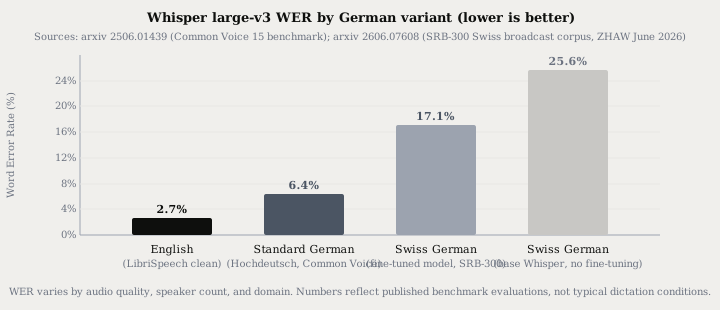
| German variant | Whisper large-v3 WER | Benchmark |
|---|---|---|
| English (LibriSpeech clean) | ~2.7% | OpenAI model card |
| Standard German (Hochdeutsch) | ~6.4% | Common Voice 15, arxiv 2506.01439 |
| Swiss German, fine-tuned model | ~17.1% | SRB-300, arxiv 2606.07608 |
| Swiss German, base Whisper | ~25.6% | SRB-300, arxiv 2606.07608 |
Austrian standard German with Hochdeutsch pronunciation sits closer to the 6-8% range under good recording conditions. Heavy Bavarian or Viennese dialect audio moves toward the Swiss German range and benefits from the same fixes.
Fix 1: Specify the language explicitly
Whisper auto-detects language by sampling the first 30 seconds of audio. On short clips, audio that starts with background noise or silence, or recordings where German is mixed with English, auto-detection can identify the audio as a different language. When that happens, every subsequent word is generated under the wrong language model and errors exceed 50%.
Setting the language parameter removes the ambiguity entirely:
whisper audio.wav --language de --model large-v3-turbo
In the Python API:
import whisper
model = whisper.load_model("large-v3-turbo")
result = model.transcribe("audio.wav", language="de")
Many desktop dictation apps expose a language selector in their settings. Setting this to German (or to the specific variant code where supported) is the lowest-effort fix with the most consistent impact.
Fix 2: Use the large or medium model
Model size matters more for German than for English. German morphology includes long compound words (Donaudampfschifffahrtsgesellschaft is a real word), case inflections, and consonant clusters that require more parameters to resolve correctly. The tiny model produces a substantially higher error rate on German than its English WER suggests.
| Whisper model | RAM | English WER | Notes for German |
|---|---|---|---|
| tiny (39M params) | ~390 MB | ~5.7% | Avoid - poor German morphology handling |
| base (74M params) | ~740 MB | ~4.2% | Only for short, slow, clear Hochdeutsch |
| small (244M params) | ~490 MB | ~3.4% | Acceptable for casual notes |
| medium (769M params) | ~1.5 GB | ~2.9% | Solid Hochdeutsch, runs real-time on M2 |
| large-v3-turbo (809M params) | ~6 GB | ~3.0% | Best practical German quality, fast |
The large-v3-turbo model is the practical default for German. Pruned from the full large-v3 decoder (from 32 layers to 4), it retains nearly identical WER while running 6-8x faster than large-v3. On Apple Silicon with 16 GB unified memory or an NVIDIA GPU with 6+ GB VRAM it runs at real-time speed.
If hardware constraints require a smaller model, medium is the next reasonable choice - it performs noticeably better than small on German compound words and produces fewer substitution errors on technical vocabulary.
Fix 3: Microphone quality
The single largest driver of real-world WER in German dictation is audio quality, not model choice. German consonant clusters (such as Strumpfhose, Lichtschutzfaktor, or Zwetschgendatschi) and vowel length distinctions are easily blurred by a laptop microphone at 60 cm from the speaker.
Moving from a built-in laptop microphone to a USB desk microphone or a headset consistently cuts real-world WER by 5-10 percentage points across languages. For German, where morphology already increases error rates, this improvement is especially valuable. A headset at 15-20 cm from the mouth with directional pickup eliminates most room reverberation and reduces the substitution errors that compound words are prone to.
If you record in a room with significant echo or background noise, closing windows and using a noise-cancelling desk microphone will improve accuracy more than upgrading from medium to large-v3-turbo.
Fix 4: Fine-tuned models for dialect work
For Swiss German, Bavarian, or other dialect-heavy use cases, base Whisper at 25.6% WER on broadcast audio is not production-usable for most tasks. Two paths are available.
Community fine-tunes on HuggingFace. German fine-tuned Whisper models are available as drop-in replacements in whisper.cpp and faster-whisper. Examples include primeline/whisper-large-v3-german (fine-tuned on standard German broadcast data) and TheChola/whisper-large-v3-turbo-german-faster-whisper. These load in any tool that accepts a HuggingFace model path and run without retraining.
Domain-specific fine-tuning. For specialised domains - medical dictation, legal transcription, technical engineering - collecting even 20-50 hours of domain audio and fine-tuning with LoRA typically reduces WER substantially within that vocabulary. The ZHAW study achieved a 17.1% WER improvement on Swiss broadcast audio using a full 300-hour corpus; targeted LoRA fine-tuning on a narrower domain can match that with significantly less data.
For Austrian standard German with minimal dialect features, fixing the microphone quality and upgrading to large-v3-turbo often brings WER into the 7-10% range without any fine-tuning.
Local Whisper vs cloud for German
Cloud German transcription services (Google Chirp, Deepgram, AssemblyAI) benefit from broader training data coverage and heavier inference hardware. For standard German, that typically produces a 2-4 percentage point WER advantage over local Whisper. For Swiss German, the gap may be larger because cloud providers have invested in dialect-specific German models.
For standard German, local Whisper large-v3-turbo at ~6-8% real-world WER is close enough to cloud services that accuracy is rarely the deciding factor. The deciding factor is whether your audio - dictated correspondence, meeting notes, medical consultation recordings - leaves your device.
| Whisper large-v3-turbo (local) | Cloud services | |
|---|---|---|
| Standard German WER | ~6-8% real-world | ~4-6% real-world |
| Swiss German WER | ~25% base, ~17% fine-tuned | Better (more dialect training data) |
| Privacy | Audio stays on device | Audio uploaded to vendor |
| Works offline | Yes | No |
| Cost | Free after model download | Per-minute or per-seat billing |
| Dialect improvement | Community fine-tunes (HuggingFace) | Vendor-specific, subscription |
For medical, legal, or any domain where recording content is sensitive, the 2-4 point WER gap in favour of cloud is hard to justify against the privacy exposure. For Swiss German specifically, evaluating dialect-fine-tuned community models before committing to a cloud service is worth the time.
The short version
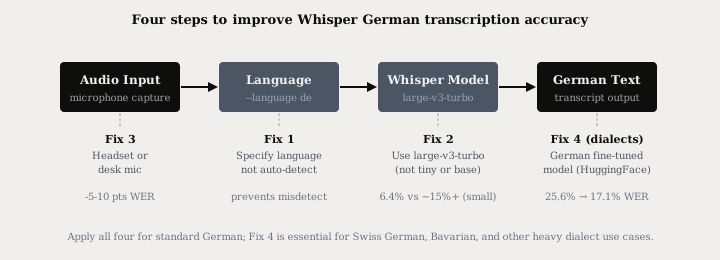
Standard German lands at ~6.4% WER with base Whisper large-v3 on Common Voice benchmark audio. Swiss German dialects sit at ~25.6% WER without fine-tuning; a 300-hour Swiss broadcast fine-tune from ZHAW brought this to ~17.1%. The four practical fixes are: specify --language de to prevent misdetection, use large-v3-turbo or medium (not tiny or base), use a headset or desk microphone at close range, and for heavy dialect work switch to a German fine-tuned community model from HuggingFace.
Typilot ships local Whisper for dictation in any app - audio never leaves your device, and the 3-day free trial requires no credit card. The security page documents exactly what is transmitted (nothing, for voice). For a full model comparison covering all local speech-to-text options in 2026, see best local speech-to-text models in 2026. For the model-size trade-offs in detail, see run Whisper locally for dictation.
Common questions.
How accurate is Whisper for German transcription?+
Whisper large-v3 achieves around 6.4% word error rate on standard German (Hochdeutsch) on the Common Voice 15 benchmark - roughly double its 2.7% English baseline, but within practical usability. Swiss German dialects score around 25.6% WER with base Whisper large-v3, according to a June 2026 evaluation on the SRB-300 Swiss broadcast corpus. A fine-tuned model on that corpus reached approximately 17.1% WER.
Why is Whisper less accurate in German than in English?+
Two factors: training data volume and linguistic complexity. German has more training data than low-resource languages but less than English, so it performs near the middle of the language range. German morphology - compound words, case inflections, and consonant clusters - also increases substitution errors compared to English under the same audio conditions. Swiss German and other dialect audio have even less representation in Whisper's training data, which explains the large accuracy gap between Hochdeutsch (~6.4% WER) and Swiss German dialects (~25.6% WER).
How do I improve Whisper German transcription accuracy?+
Four steps consistently reduce WER on German audio: (1) Specify the language explicitly as "de" rather than relying on auto-detection, which can misidentify short or noisy clips. (2) Use the large-v3-turbo or medium model - the tiny and base models handle German morphology poorly. (3) Use a headset or desk microphone at 15-20 cm from the mouth instead of a built-in laptop mic; this alone cuts real-world WER by 5-10 percentage points. (4) For Swiss German or other heavy dialects, use a German fine-tuned community model from HuggingFace such as primeline/whisper-large-v3-german.
Does Whisper support Swiss German or Austrian German dialects?+
Base Whisper large-v3 performs poorly on Swiss German, scoring around 25.6% WER on a Swiss radio and television broadcast evaluation corpus (SRB-300, ZHAW June 2026). Austrian standard German with Hochdeutsch pronunciation performs closer to standard German, roughly 6-10% WER in good recording conditions. For Swiss German, community fine-tuned models from HuggingFace can reduce WER to approximately 17%, but the dialect gap is fundamental and cannot be eliminated by application configuration alone.