Voxtral vs Whisper for Local Dictation
Mistral Voxtral Mini 3B hits 1.86% WER - better than Whisper turbo - but needs 9.5 GB GPU RAM and covers 13 languages only. When to use each for local speech-to-text.
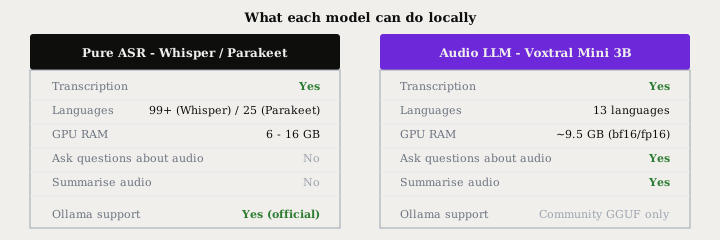
Mistral's Voxtral Mini 3B achieves 1.86% word error rate on LibriSpeech clean English - lower than Whisper large-v3-turbo's ~3.0% - but it is not a drop-in replacement for Whisper. Voxtral is an audio language model: it stacks a Ministral-3B text decoder on top of a Whisper-large-v3 encoder, which lets it answer questions about audio and generate summaries on top of transcription. The trade-off is a higher memory floor (about 9.5 GB GPU RAM versus ~6 GB for Whisper turbo) and narrower language coverage (13 languages versus Whisper's 99+). For pure local dictation, Whisper and Parakeet remain the more practical defaults; Voxtral becomes relevant when you want to interrogate your audio, not just transcribe it.
Here is how the two approaches compare across every dimension that matters.
What Voxtral actually is
Mistral AI released Voxtral on 15 July 2025 under the Apache 2.0 licence. The model family has two variants: Voxtral Small 24B for server workloads and Voxtral Mini 3B for local and edge deployment. Both share the same architecture: a bidirectional Whisper-large-v3 audio encoder feeds a 4-frame projector into a Ministral-3B causal language model. The encoder turns audio into a sequence of roughly 375 tokens per 30 seconds of audio; the LM backbone then generates text from those tokens - in transcription mode, question-answering mode, or summarisation mode depending on the system prompt.
This is architecturally different from Whisper, which has its own encoder-decoder and is purpose-built for transcription. Parakeet TDT uses a FastConformer encoder with a transducer decoder optimised for streaming. Voxtral is the first of the three that can answer "what was the action item at 4 minutes 20 seconds?" from a local model.
Transcription accuracy
On LibriSpeech clean test - the standard read-speech benchmark - Voxtral Mini 3B posts 1.86% word error rate according to Mistral's model card. That is modestly better than Parakeet TDT 0.6B v3 (~1.9%, NVIDIA benchmarks) and noticeably better than Whisper large-v3 (~2.7%) and large-v3-turbo (~3.0%).
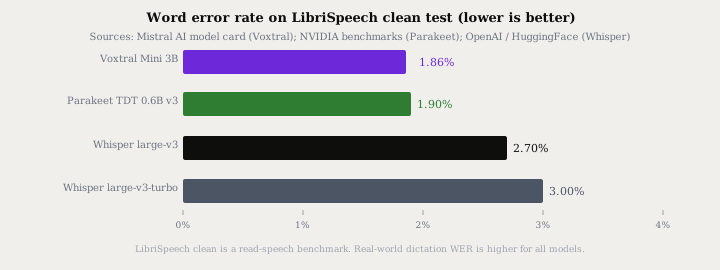
One important caveat: LibriSpeech uses clean read speech from audiobooks with professional recording quality. Real-world dictation through a laptop microphone, with background noise or a non-native accent, will land in the 8-15% WER range for all four models. The benchmark numbers are useful for ranking models but they do not predict field performance.
The Voxtral architecture also processes audio in up to 30-minute chunks (32K token context), compared to Whisper's 30-second fixed window. For batch transcription of long recordings, that removes the stitching overhead that can cause Whisper to produce duplicate or missing sentences at chunk boundaries.
Hardware requirements
Voxtral Mini 3B requires about 9.5 GB of GPU memory when loaded in bf16 or fp16. On Apple Silicon Macs, that means 16 GB of unified memory as a practical minimum (the model shares the same memory pool as the OS and other applications). On Windows or Linux with a dedicated GPU, an RTX 4060 Ti 16 GB or an RTX 4080 12 GB provide comfortable headroom.
Whisper large-v3-turbo (809M parameters) fits in around 6 GB of RAM, which makes it usable on base-tier MacBook Air 8 GB machines and on modest consumer GPUs where Voxtral would not load.
| Model | Parameters | GPU RAM | WER (LibriSpeech clean) |
|---|---|---|---|
| Voxtral Mini 3B | 3B (LM backbone) | ~9.5 GB | 1.86% |
| Parakeet TDT 0.6B v3 | 600M | ~16 GB unified | ~1.9% |
| Whisper large-v3 | 1.55B | ~10 GB | ~2.7% |
| Whisper large-v3-turbo | 809M | ~6 GB | ~3.0% |
Language coverage
Voxtral Mini 3B supports 13 languages for transcription: English, Chinese, Hindi, Spanish, Arabic, French, Portuguese, Russian, German, Japanese, Korean, Italian, and Dutch. That covers the most-spoken languages globally but omits many European and South-East Asian languages that Whisper handles.
Whisper large-v3-turbo retains the full large-v3 encoder, so it keeps Whisper's 99+ language coverage. If you dictate in Turkish, Vietnamese, Finnish, Ukrainian, or any language outside the Voxtral 13, Whisper is the only option between the two.
Parakeet TDT 0.6B v3 sits in between: 25 European languages with no support for Chinese, Japanese, Korean, Arabic, or Hindi.
The audio understanding difference
The differentiating capability of Voxtral is not transcription accuracy - it is the ability to reason about the audio contents. With a single local model call, you can:
- Transcribe a 20-minute interview in one pass without chunking
- Ask "what are the three main concerns raised?" and receive a structured answer
- Translate the transcript into another of the 13 supported languages in the same request
- Generate a summary or extract action items, all without a separate LLM call
Pure ASR models like Whisper and Parakeet output only the transcript. Feeding that transcript to a local LLM for summarisation is possible - and it is exactly what tools like Typilot's meeting notes feature do via a local Ollama model - but it is a two-step pipeline. Voxtral collapses those steps into one.
Running Voxtral Mini 3B locally
Voxtral is not in the official Ollama library. The primary installation path is Python with transformers >= 4.54.0 and mistral-common:
pip install transformers>=4.54.0 mistral-common torch
from transformers import AutoProcessor, VoxtralForConditionalGeneration
import torch

model_id = "mistralai/Voxtral-Mini-3B-2507"
processor = AutoProcessor.from_pretrained(model_id)
model = VoxtralForConditionalGeneration.from_pretrained(
    model_id, torch_dtype=torch.bfloat16, device_map="auto"
)
A community-maintained GGUF file (epapanita/Voxtral-Mini-3B-2507-gguf on Hugging Face) allows loading with llama.cpp, though audio tokenisation support in the C++ runtime is still maturing. Whisper, by contrast, has battle-tested binaries via whisper.cpp, faster-whisper, and pre-packaged installers on all three desktop platforms.
For offline dictation - the task of pressing a hotkey, speaking a sentence, and having the text injected at the cursor in any application - Whisper's tooling ecosystem is considerably more mature than Voxtral's at this point.
Which to use
Use Whisper large-v3-turbo or Parakeet TDT v3 for local dictation: lighter RAM footprint, broad language coverage, and native support in whisper.cpp and desktop apps. Use Voxtral Mini 3B when you need to query or summarise recordings locally in a single model call - it is the better tool for batch audio understanding, not for real-time typing.
Practical guidelines:
- Pure dictation, any language except the Voxtral 13 - Whisper large-v3-turbo is the only option with 99+ language coverage.
- English or European dictation, 8 GB machine - Whisper large-v3-turbo at 6 GB fits where Voxtral (9.5 GB) and Parakeet (16 GB) do not.
- English accuracy + speed, 16+ GB unified memory - Parakeet TDT 0.6B v3 is faster and marginally more accurate than Voxtral on pure transcription, and it is available in Ollama and native desktop apps today.
- Batch transcription + summarisation or Q&A in one pass - Voxtral Mini 3B is the cleanest local option; it removes the need for a separate LLM call on the transcript.
- Meeting notes, diarisation, action-item extraction - a Whisper-plus-Ollama pipeline (as in Typilot's meeting notes feature) gives you fine-grained control over the ASR and LLM models independently; Voxtral's single-model approach trades that control for simplicity.
For more on picking between the pure ASR models, Whisper large-v3-turbo versus Parakeet TDT 0.6B v3 covers the trade-offs in detail. For a broader ranking of local speech models including Moonshine and Canary, best local speech-to-text model 2026 has the full picture.
The short version
Voxtral Mini 3B (Mistral, July 2025, Apache 2.0) beats Whisper large-v3-turbo on LibriSpeech accuracy (1.86% vs 3.0% WER) and adds audio Q&A and summarisation to transcription. The cost is a higher memory requirement (~9.5 GB GPU RAM vs ~6 GB) and support for 13 languages only. For local dictation in real time, Whisper and Parakeet are still the practical defaults - lighter, better-tooled, and available in Ollama today. Voxtral is worth using when batch audio understanding in a single local call matters more than frictionless setup.
Try Typilot free for 3 days - local Whisper-powered dictation with no audio upload, no subscription. The security page documents the full on-device pipeline.
Common questions.
Is Voxtral better than Whisper for local transcription?+
Voxtral Mini 3B scores 1.86% WER on LibriSpeech clean versus ~3.0% for Whisper large-v3-turbo, so it is more accurate on clean English audio. However, Voxtral needs about 9.5 GB GPU RAM (versus ~6 GB for Whisper turbo), supports only 13 languages (versus 99+ for Whisper), and is not yet available in the official Ollama library. For pure local dictation Whisper remains the easier, lighter choice.
Can I run Voxtral Mini 3B fully offline on my laptop?+
Yes, once the model weights are downloaded (about 6-7 GB), all inference runs on your device with no network calls. You need a GPU with at least 9.5 GB of memory, or 16 GB of Apple Silicon unified memory. Install via Python with transformers >= 4.54.0 and mistral-common, or use a community GGUF file with llama.cpp.
What languages does Voxtral Mini support?+
Voxtral Mini 3B supports 13 languages: English, Chinese, Hindi, Spanish, Arabic, French, Portuguese, Russian, German, Japanese, Korean, Italian, and Dutch. For any language outside that list - including Turkish, Vietnamese, Ukrainian, or Finnish - Whisper large-v3-turbo with its 99+ language support is the better option.
What can Voxtral do that Whisper cannot?+
Voxtral can answer questions about audio content and generate summaries from the audio directly, without a separate LLM call. It processes up to 30 minutes in one pass with a 32K token context window. Whisper outputs a transcript only; summarisation requires a second step with a language model such as a local Ollama model.