Parakeet Redux: 178 MB Local Speech at 113x Speed
M87 Labs compressed NVIDIA Parakeet to 178 MB with ternary weights: 113x real-time on CPU, slight accuracy drop on noise, better on clean audio. Released 21 Sep 2026.
M87 Labs released Parakeet Redux on 21 September 2026, compressing NVIDIA's Parakeet TDT 0.6B v3 speech recognition model from 1.2 GB to 178 MB by replacing every encoder weight with a ternary value: -1, 0, or +1. On eight x86 CPU cores it runs at 113x real-time - meaning a 60-minute recording transcribes in about 32 seconds with no GPU. On an M2 Mac's integrated GPU it reaches 43x real-time. The compression costs accuracy on noisy audio (9.04% word error rate versus 6.72% for the original), while surprisingly improving on long-form clean speech (2.51% versus 2.71%).
Here is how the compression works, what the benchmark data shows, and when Parakeet Redux is the right engine for a local speech pipeline.
What M87 Labs changed
The Parakeet TDT 0.6B v3 architecture has two main pieces: a FastConformer encoder and a Token-and-Duration Transducer (TDT) decoder. M87 Labs kept the decoder at full floating-point precision and ternarised only the encoder weights - the part that converts raw audio frames into learned representations.
Each encoder weight is mapped to one of three values. Five ternary values pack into one byte (since 3^5 = 243 fits in a byte), which is how a 1.2 GB FP16 model shrinks to 178 MB - a 6.7x compression. The decoder and vocabulary remain unchanged, so the model still outputs the same token set and supports the same 25 European languages as the original.
The practical consequence: Parakeet Redux loads and runs on any CPU with 8 or more cores. There is no CUDA, Metal, or ROCm requirement. Fused CPU kernels in M87 Labs' kestrel inference framework handle the ternary multiply-accumulate step efficiently without a GPU.
Speed
On eight x86 CPU cores, Parakeet Redux transcribes at 113x real-time: one second of inference processes 113 seconds of audio. On an Apple M2, it runs at 38x real-time using the CPU and 43x using the integrated GPU (via Metal Performance Shaders). These measurements come from M87 Labs' own benchmarks published with the model card.
To put 113x real-time in context: Whisper large-v3-turbo on the same CPU hardware runs well below 1x real-time for most users without GPU acceleration - you wait longer than the recording takes. Parakeet Redux inverts that relationship entirely on CPU.
| Hardware | Speed |
|---|---|
| 8-core x86 CPU (Parakeet Redux) | 113x real-time |
| M2 integrated GPU / MPS (Parakeet Redux) | 43x real-time |
| M2 CPU (Parakeet Redux) | 38x real-time |
For reference: the full Parakeet TDT v3 on an NVIDIA GPU with CUDA achieves roughly 60-80x real-time. Parakeet Redux on CPU beats that on raw throughput, at the cost of accuracy described below.
Accuracy: the ternary trade-off
Ternary weights are less expressive than FP16: the encoder has fewer distinct values to represent fine acoustic differences. The effect shows up most clearly where acoustic similarity matters most - noisy environments where the model must separate speech from background.
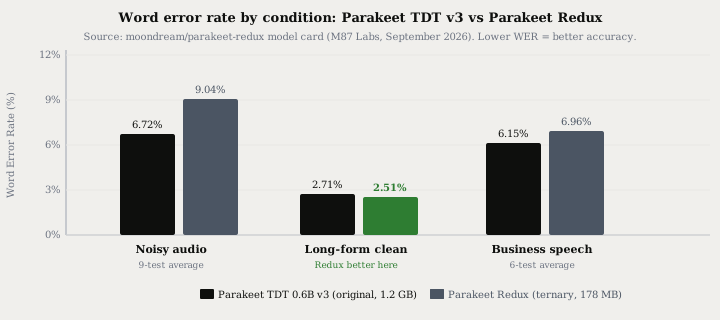
| Condition | Parakeet TDT v3 | Parakeet Redux | Difference |
|---|---|---|---|
| Noisy audio (9-test avg) | 6.72% | 9.04% | +2.32 percentage points |
| Long-form TED-LIUM (11 talks) | 2.71% | 2.51% | -0.20 pp (Redux better) |
| Business speech | 6.15% | 6.96% | +0.81 pp |
The long-form result is counterintuitive. On 10-20 minute TED talks recorded in quiet conditions, Parakeet Redux is more accurate than the original. One plausible explanation: the reduced-capacity encoder is less prone to overfitting transient acoustic artefacts - the short-duration signals that occasionally cause the full model to insert words that are not there. On clean, well-paced speech with consistent signal quality, less expressive weights are enough.
The noisy audio result is the clearest weakness. A 2.3 percentage point WER increase in noisy environments is meaningful - it corresponds to roughly one extra word error per 45 words of speech recorded in a room with background sound.
When Parakeet Redux is the right choice
CPU-only machines without a GPU. The primary use case. If you are building a transcription pipeline on a server without GPUs, or running on a MacBook without enough VRAM headroom for the full model, Parakeet Redux delivers real-time transcription at any CPU thread count above four.
Clean audio at scale. Podcast processing, audiobook transcription, conference recordings with directional microphones, and similar sources with good signal quality get the long-form accuracy improvement alongside the speed gain.
Embedded and edge deployments. At 178 MB, Parakeet Redux fits in environments where a 1.2 GB download or memory footprint is prohibitive.
When to stay with the full Parakeet TDT v3
Noisy recordings. Open offices, outdoor interviews, phone calls over compressed audio, or any scenario with significant background sound. The 2.3 percentage point noisy WER penalty is not negligible for production accuracy requirements.
When a GPU is available. The full model on NVIDIA CUDA hardware runs at 60-80x real-time with better accuracy - a better deal when the GPU exists. On Apple Silicon with 16+ GB of unified memory the full model also runs well via Metal.
Any language outside the 25 supported. Both models share the same language set, so this is not a differentiator between them, but it is the reason to consider Whisper large-v3-turbo instead for multilingual audio (99+ languages, ~6 GB, GPU-optional). See Whisper large-v3-turbo vs Parakeet for that comparison.
Getting Parakeet Redux
Parakeet Redux is on HuggingFace at moondream/parakeet-redux. M87 Labs' kestrel inference framework integrates it with VAD and long-audio segmentation via pull request #247 in the m87-labs/kestrel repository.
# Via HuggingFace Hub (Python)
pip install huggingface_hub
huggingface-cli download moondream/parakeet-redux
As of September 2026, Parakeet Redux is not yet available as an ollama pull command - it requires kestrel or a direct HuggingFace integration. The model card at moondream/parakeet-redux includes usage examples for both CPU and MPS (Apple Silicon) inference.
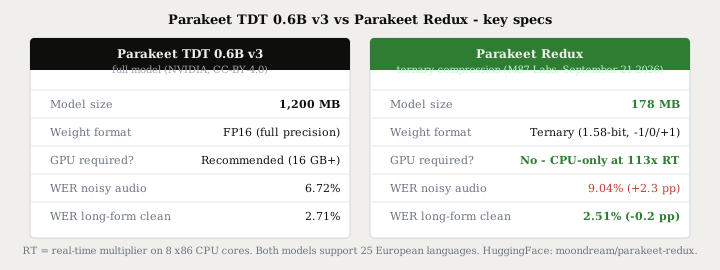
Parakeet Redux is the right choice when you need fast, GPU-free local transcription and your audio is clean. For noisy environments - open offices, outdoor recordings, compressed phone audio - the full Parakeet TDT v3 maintains better accuracy. Both models keep audio entirely on-device: nothing is uploaded.
What ternary compression means for local AI
Parakeet Redux is part of a broader trend: taking high-quality open-weight models and compressing them aggressively enough to remove the hardware requirement entirely. BitNet and similar ternary LLM work has shown that language models can survive aggressive quantisation with acceptable quality loss. Parakeet Redux applies the same idea to speech encoder weights, and the TED-LIUM result suggests the quality floor is higher than expected on clean audio.
The practical implication for local speech-to-text: you no longer need a GPU to get real-time transcription with Parakeet-class accuracy on clean recordings. A machine that would have been limited to Whisper tiny or small for CPU-only use can now run a model that beats Whisper large on English accuracy in clean conditions.
For the broader model landscape - including where Whisper, Canary-Qwen, and Moonshine fit - see best local speech-to-text model 2026.
The short version
M87 Labs released Parakeet Redux on 21 September 2026 - 178 MB, ternary encoder weights, 113x real-time on 8 CPU cores. Accuracy drops 2.3 percentage points on noisy audio (6.72% to 9.04% WER) but improves slightly on clean long-form recordings (2.71% to 2.51%). Use it when you need GPU-free real-time transcription on clean audio; keep the full Parakeet TDT v3 for noisy environments and when a GPU is available. Model at moondream/parakeet-redux; inference via M87 Labs' kestrel framework. For local dictation that injects transcribed text into any app on your machine - with on-device Whisper, VAD, and no audio upload - Typilot offers a 3-day free trial. The security page documents what stays on your machine and what never leaves it.
Common questions.
What is Parakeet Redux?+
Parakeet Redux is a compressed version of NVIDIA's Parakeet TDT 0.6B v3 speech recognition model, released by M87 Labs on 21 September 2026. Its encoder weights are replaced with ternary values (-1, 0, or +1), shrinking the model from 1.2 GB to 178 MB. It runs at 113x real-time on eight CPU cores with no GPU required.
Is Parakeet Redux as accurate as the original Parakeet?+
It depends on the audio conditions. On noisy recordings, Parakeet Redux scores 9.04% word error rate against 6.72% for the original - a meaningful accuracy drop. On clean long-form speech (TED-LIUM benchmark), Redux is slightly more accurate at 2.51% versus 2.71%. For quiet studio or podcast audio, Redux holds up well; for noisy environments the full model is the better choice.
Does Parakeet Redux keep audio private?+
Yes. Like the full Parakeet TDT v3, Parakeet Redux runs entirely on-device. Audio is processed locally through the kestrel inference framework or a direct HuggingFace integration - nothing is uploaded to a server. Once the 178 MB model is downloaded, it runs fully offline.
How do I run Parakeet Redux locally?+
Parakeet Redux is available at moondream/parakeet-redux on HuggingFace. Download it with the HuggingFace Hub CLI and run it through M87 Labs' kestrel framework. As of September 2026 it is not yet available via "ollama pull". The model card includes CPU and MPS (Apple Silicon) usage examples.